21 May

second Agonalia
feast of Sts. Constantine and Helena
1500 Jean Wast associated with Martin Chambiges in the construction of the transcept of the cathedral of Beauvais
1502 discovery of St. Helena Island
1762 James Adam sends first copies of Il Campo Marzio dell.Antica Roma to London
1877 death of Sir Matthew Digby Wyatt
1878 foundation stone laid at Herrenchiemsee
2002 Double Theater Day

transparent models
Quondam: Strasbourg
1997.05.21

98052101.db ICM, plans
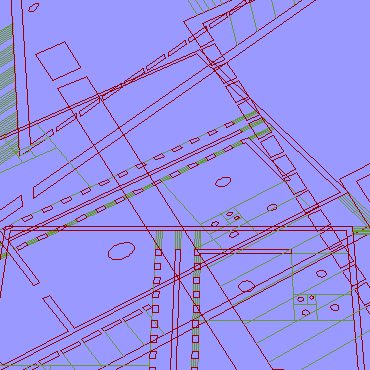
98052102.db ICM, Porticus Theodosius, plans

May 21st - the Agonalia
1999.05.21 11:24
Agonalia postscript
1999.05.21 16:40

gallery 1999
pause in tsPOWa
schizophrenia + architectures

1999.05.21

Hybrid (OE)
2000.05.21

00052101.db Janus Quadrifons, plan
00052102.db Extrusion Play 000, model, perspective

Re: J.J Norwich and Constantine's tomb
2002.05.21 07:34
2002.05.21 07:49
the other Agonalia -- 9 January
2002.05.21 08:23
Re: Lebbeus Woods in Paris and New York
2002.05.21 12:58
2002.05.21 14:16
Jerusalem SKY
2002.05.21 15:27
the first Agonalia
2002.05.21 15:45

quondam calendar
May 21 [2003]
Outside Inside Density
ideas
2003.05.21

PHILADELPHIA!!
2006.05.21 15:15
a quondam two-faced celebration
2006.05.21 16:17
reading KINETIC ARCHITECTURE lately?
2006.05.21 17:42
Threadbare Central
2006.05.21 18:44
2006.05.21 19:05

ideas
2006.05.21

May 21st - the Agonalia
1999.05.21 11:24

Agonalia - a festival in honor of Janus celebrated in Rome on the 9th of January and the 21st of May.

Janus is my favorite Roman god.

Janus - an old Italian deity. He was represented with a face on the front and another on the back of his head. The month of January was sacred to him, as were all other beginnings. The myth makes him a king of Latium or Etruria, where he hospitably received Saturn when expelled by Jupiter from Crete. He had a small temple in the Forum, with two doors opposite to each other, which in time of war stood open and in time of peace were shut; the temple was trice closed on this account. With reference to his temple, the deity was called Janus geminus or Janus Quirinus.

I like Janus because he can see in front of him and he can see behind him--into the future and into the past? Also, I like to wonder whether Janus was "two faced" or was he schizophrenic?

Within his large plan of the Campo Marzio, Piranesi applies the label "Circus Agonalis sive Alexandri" to the original Circus of Domitian which is today Rome's Piazza Navona. Albeit obscure information, Piranesi was indeed correct in his designation because the emperor Alexander Severus rebuilt the Circus of Domitian and renamed it in honor of Janus. It is fun to imagine all the big goings-on over 1700 years ago today within what is now the Piazza Navona.

Another monument in honor of Janus that still stands in Rome today is the Arch of Janus Quadrifrons, which is in the Forum Boarium. It is one of those unique four-way arches, and, according to Banister Fletcher, is "of poor design." What is most interesting about this arch, however, is that it was constructed under Constantine the Great after he converted to Christianity. I believe this signifies two important facts. First, the aristocratic and pagan population of Rome still had tremendous influence and power. Second, whoever designed this arch was extremely clever in that Janus, precisely because of his "two faced" nature, was the perfect god to reflect Constantine's own political position--exactly because of his conversion from paganism to Christianity, Constantine himself is Rome's ultimate Janus-like emperor. [Personally, I can't help but believe that it was Constantine's mother Helena that thought all this poignant symbolism through.] And, in an almost too good to be true sense, the Arch of Janus may well have predicted (looked towards) European architecture's next 1200 years: Banister Fletcher notes "it has a simple cross-vault with embedded brick box-ribs at the groins, affording a further instance of the progressive character of Roman construction techniques: such ribs are possibly the prototypes of Gothic rib vaults." [Fletcher is being a little two faced himself here -- first the Arch of Janus is not good design, and then the arch is progressive construction!] Could it really be that the first ribbed cross-vaults ever were built in late antiquity? Do these vaults, built by ancient Rome's first Christian emperor, unwittingly and uncannily prophesies a whole new future era of Western architecture? [And is it possible that Helena, besides being the first master architect of Christianity, is also the world's proto-Gothic architect?]

Constantine converted to Christianity the night before the Battle at the Milvian Bridge (October 28, 312) which lead into the City of Rome. He saw a vision of the (Christ) Cross in the sky, and hence ordered his troops to paint the (Christ) Cross on their shields. Constantine was victorious over the usurpative emperor Maxentius, and on October 29 entered Rome in triumph. Constantine's mother, St. Helena, is most known for having discovered the True Cross in Jerusalem (most recently dated c. 324-25). If you asked me, I'd say the "signs" surrounding this incredible mother-son team are still appearing.


Agonalia postscript
1999.05.21 16:40

As odd as it sounds, only after sending the initial Agonalia post did two things occur to me:

1. the space created by the plan of the four-way Arch of Janus essentially forms a cross.

2. Only Helena is honored as a saint in the Roman Catholic Church, and her feast is celebrated the 18th of August. The Greek Orthodox Church, on the other hand (or is it other face?), honors both Helena and Constantine as saints, and they share a combined feast day, which happens to be today, May 21st.


a quondam two-faced celebration
2006.05.21 16:17

The third Agonalia--the festival of Veiovis, "one of the oldest of the Roman gods. He is a god of healing, and was later associated with the Greek Asclepius. He was mostly worshipped in Rome and Bovillae in Latium. On the Capitoline Hill and on the Tiber Island temples were erected in his honor. In spring, goats were sacrificed to avert plagues."
--Micha F. Lindemans

I've know a little about the Agonalia since April 1998 when I translated all the Latin labels of Piranesi's Ichnographia Campi Martii. In 1972 I often walked through the room where Edward T. Stotesbury died, but I didn't know that then--now part of a little field closest to the columns. I play Napoleon at St. Helena nearly every day, and I didn't win during lunch today. Today is the last day to see Princess Grace's wedding dress--the first time I saw it was late winter/early spring 1972.

Constantine the Great died in a suburban villa of Nicomedia, today's Izmit, Turkey, 22 May 337.


««««

»»»»

0044 0278 0566 1435 1498 8578 9442 9443
www.quondam.com/06/0521.htm

Quondam © 2009.09.11