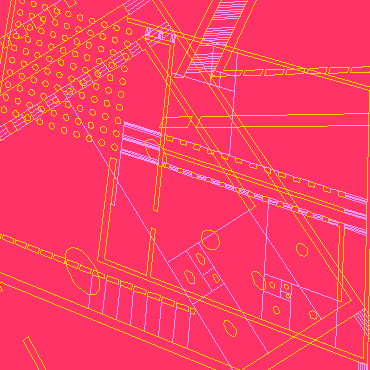
24 May

2004 Otto and Einstein at Princeton

Quondam
1997.05.24

interview 1
1999.05.24 11:24
1999.05.24 18:01
interview 2.1a
1999.05.24 22:25
1999.05.24 22:25
Re: the Agonalia
1999.05.24

000524a.db House in Laguna 002, model
00052402.db mesh surface building 001, model, elevations, perspectives
00052403.db mesh surface building 002, model, perspectives
00052404.db mesh surface building 004, model, perspectives
00052405.db mesh surface building 005, model, perspectives
00052406.db mesh surface building 006, perspectives
00052407.db mesh surface, perspective
00052408.db mesh surface, models
00052409.db mesh surface, models, perspectives
00052410.db House in Laguna 002, perspectives

01052401.db rotated extrusion mesh surfaces, models

Re: Slintered Urbanism
2002.05.24
Re: watching OR...LIKE, venturi-koolhaas
2002.05.24
Re: SEEK YOU
2002.05.24
Re: watching some swans...
2002.05.24
Re: explain your sentence...please.
2002.05.24
2002.05.24

Art that is Otto and Einstein at Princeton
001 002 003 004 005 006 007 008 009 010 011 012 013 014 015 016 017 018 019 020 021 022 023 024 025 026 027 028 029 030 031 032 033
2004.05.24

hotrod architecture
2005.05.24 09:02
2005.05.24 14:11
2005.05.24 15:22
2005.05.24 16:11
2005.05.24 16:20
nice urban housing in philadelphia
2005.05.24 09:20

The Odds of Ottopia and Leaving Obscurity Behind
2006.05.24

interview 1
1999.05.24 11:24

you:
I do think you are on to something. From the many dimensions that I think the (form/content) could take, I think yours is an aesthetic revelation of what digital can/could be/come.

me:
Digital media does indeed take on multitudinous forms and holds voluminous content, and thus the context of my work is small in comparison. Specifically, I deal with "digitally translating" architecture(s) via a (web)site in cyberspace utilizing simple hypertext markup language (HTML) files that often include individual image files. The media I use to maintain a virtual architectural environment are limited, but not limiting. In terms of programming sophistication, what I do is at the low end of web technology, and I purposely remain there to keep my delivery of data as universal as possible. For example, I prefer to not offer a message requiring capabilities beyond the average web browser. Some designers, or perhaps most designers consider the capabilities of basic HTML and basic web browsers as undesirable or unnecessary creative barriers. I believe there is an inherent fallacy in such thinking because all data, once it becomes digital, acquires the attribute of (virtually) infinite possibilities, and, therefore, creativity within the digital realm can automatically explore a considerably wide berth, even if only using the most common computer-aided means. Simply put, I work within the more common digital infinities.

The term "aesthetic revelation" brings to mind the topless bathing-suit for women -- the aesthetics and revelation there are self-evident. I'm not exactly sure, however, how the same term applies to my work. If my work incorporates an aesthetic, that aesthetic then stems from investigating digital media's infinity through seemingly limited mechanisms. Most recently, I have become fond of the notion that "space" within cyberspace is always readily abundant, and, via hyperlinks, movement and circulation from "space" to "space" is easily facilitated. Moreover, hyperlink transitions within cyberspace offer the same abundant possibilities as the "space" itself since any channel or passage is instantly creatable. Because of this abundance, I do not regret cyberspace's basic lack of the third dimension. Indeed, generating a real cyber space and a real virtual place utilizing only two dimensions is our time's greatest architectural challenge.

The quest for a real two-dimensional architecture sheds new light upon the work of G.B. Piranesi, whose two-dimensional architectural oeuvre vastly outnumbers his three-dimensional manifestations. Nonetheless, Piranesi was a master of both two-dimensional and three-dimensional architectures. It is, however, Piranesi's two-dimensional work that is particularly poignant today -- albeit non-digital, all of Piranesi's architectural engravings reflect the work of the first consummate virtual architect. Above all, Piranesi's Carceri (Prisons) reveal the "torture" that a quest for real two-dimensional architecture engenders. No doubt, Piranesi today would forthwith recognize and substantiate the "freedom" of the digital realm.


««««

»»»»

9445 9446 9447 9448 9449 9450 9451 9452 9453 9454 9455 9456 9457 9458 9459 9460 9461 9462 9464 9465 9466 9467 9468 9469 9470 9471 9472 9473 9474 9475 9476 9477 9478 9479 9480 9481 9482 9483 9484 9485 9486 9488 9489 9490 9491 9492 9493 9494 9495 9496 9497 9498 9499 9500 9501 9502 9503 9504 9505 9506 9507 9509 9510 9511 9512 9513 9514 9515 9516 9517 9518 9519 9520 9521 9522 9523 9524 9526 9530 9531 9532 9533 9534 9535 9536 9537 9538 9539 9540 9541 9542 9543 9544 9546 9547 9548 9549 9550 9551 9552 9553 9554 9822 9823 9824 9825 9826 9827 9828 9829 9830 9831 9832 9833 9834 9835
www.quondam.com/06/0524.htm

Quondam © 2009.08.11