08042101.db
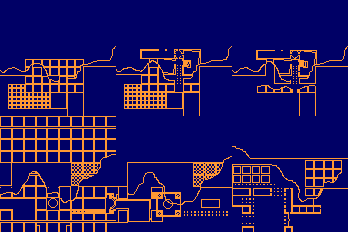
Ichnographia Quondam, Campo Marzio section 8, mirror copy plans.
| |
The Official Paradigm Shift thread
2008.05.16 11:09
"For example there were reasons in the late 19th century for architecture to change. These included changes in psychology introduced by Freud; in physics by Einstein; in mathematics with Heisenberg; and in flight with the Wright brothers. These changes caused a reaction against the Victorian and imperial styles of the period and articulated a new paradigm: modernism."
What the physics of Einstein, the mathematics of Heisenberg and the flight of the Wright brothers changed much more than architecture was warfare. [Freud basically applied the Christian notion of divine trinity being to the human psyche, thus helping humans to see themselves (and even Freud himself) as more Christian god-like.]
"With each new paradigm, whether it is the French revolution or the Renaissance, there is an early phase, which in modernism was from 1914-1939; a high phase, which in modernism occurred 1954-1968 when it was consumed by liberal capital after the war; and a period of opposition. The year 1968 saw an internal, implosive revolution, one that reacted against institutions representing the cultural past of many of the western societies. This was followed by post modernism's eclectic return to a language that seemed to have meaning. The Deconstructivist exhibition at the MoMA in 1988 put an end to this cliché and kitsch style."
First off, I wonder what the early, high and post-modern phases of the French Revolution are.
Note how modernism (as described here) does not have a phase between 1939 and 1954, i.e., during WWII and its aftermath. It looks like WWI and WWII and even the Vietnam War had a far greater effect on modernism than anything else.
So what does "war" look like in the world of architecture? Maybe, just maybe, it looks like a complete inversion of all of the above. (Like I said already, paradigm shifts require a lot of work.)
|