2000.02.12 14:25
beyond the envelop (sketch)?
John inquires:
Weren't Polshek, Goldberger and Futter adorable on Charlie Rose last night? Such happiness and glee. The envelope sketch! How whitewashy.
Steve replies:
I particularly liked the momentary, almost imperceptible awkwardness that arose when the Natural Sciences' likewise new virtual museum (i.e., all the continually updated scientific data that will be available on the museum's website) was being described by Futter as something much beyond the new Polshek building.
I'm now wondering if all the built environment of our planet is 'progressing' towards becoming a global (virtual) theme park, while cyberspace becomes the place where 'actual' 'real' data takes up residence.
2003.02.12 12:33
Re: plagiarism
Regarding architecture and plagiarism here's a short exchange from 3 August 2001:
lauf-s wrote:
See how Frank Lloyd Wright's Solomon R. Guggenheim Museum of New York reenacts Giuseppe Momo's 1932 entrance hall with double-helix ramps of the Vatican Museum.
[Michael Kaplan replied:]
Isn't the word 'plagiarism'? Even the dome is the same configuration. I noticed that when I visited the Vatican museum in 1966.
[to which lauf-s replied:]
Michael, I believe you are correct about Wright plagiarizing Momo, in that plagiarize means: to steal or pass off as one's own (the ideas or words of another); use (a created production) without crediting the source; to present as new and original an idea or product derived from an existing source. But the buildings themselves do not plagiarize each other, rather they manifest reenactment. For example, if Wright had acknowledged Momo's design, then Wright would no longer be guilty of plagiarism, but the Guggenheim as a building wouldn't actually change because of the acknowledgment.
ps 12 February 2003
Simply put, if sources are acknowledged, then plagiarism does not exist. Furthermore, reenactment exists whether a source is acknowledged or not.
Tomorrow, 13 February, is the feast of St. Catherine de Ricci, whose name some may recognize from the Dominican Motherhouse of St. Catherine de Ricci, an unexecuted design by Louis I. Kahn. St. Catherine was indeed a 'reenactor' in that she for twelve years reenacted the events leading up the Crucifixion, beginning Holy Thursday and ending Good Friday afternoon, even including the appearance of stigmata.
"Catherine is famous, even in a greater degree than other mystics who have been similarly privileged, for her extraordinary series of ecstasies in which she beheld and enacted in their order the scenes which preceded our Saviour's crucifixion. These ecstasies seem always to have followed the same course. They began when she was twenty years old in February 1542, and they were renewed every week for twelve years continuously."
--Butler's Lives of the Saints
I have to wonder whether Kahn ever took the time to research St. Catherine de Ricci while designing the Motherhouse dedicated to the Saint. Are there perhaps clues within the convent design that may suggest Kahn was aware of the Saint? Honestly, who knows. All the same, Kahn for sure did some reenacting himself with the design.
2004.02.12 16:20
Re: fresh [metabolic] breeze
Is there any truth to the rumor that Disney is planning a new theme park for somewhere in the Middle East tentatively called "Milk & Honey Land"?
| |
2004.02.12 17:54
of castles, fortifications, etc.
...of ways of perceiving building types, one is in the realm of cultural symbols. looked up a few definitions related to architecture, and some of these missing dimensions may or may not be of relevance in current events.
=====
CASTLE This is a complex symbol, derived at once from that of the house and that of the enclosure or walled city. Walled cities figure in mediaeval art as a symbol of the transcendent soul and of the heavenly Jerusalem. Generally speaking, the castle is located on the top of a mountain or hill, which suggests an additional and important meaning derived from the symbolism of level. Its shape, form and colour, its dark and light shades, all play an important prt in defining the symbolic meaning of the castle as a whole, which, in the broadest sense, is an embattled, spiritual power, ever on the watch. The 'black castle' has been interpreted as the alchemists' lair, as well as a rain cloud poised above a mountain-top. Its significance as the Mansion of the Beyond, or as the entrance to the Other World, would seem obvious enough. In a many great legends, the Castle of Darkness, inhabited by a 'Black Knight', is symbolic of the abode of Pluto; this is confirmed by Theseus' mythic journey into hell. Charon has his abode in a similar castle which is inaccessible to living men (the 'castle of no return' of folktales). In the legendary heaven of Nordic tradition, the same meaning is to be found. Melwas, the abductor of Guinevere, dwells in a castle surrounded by a deep moat, the only means of access between two bridges difficult to negotiate. According to Krappe, it is very possible that the underlying symbolism of all mediaeval tales and legends about a castle owned by a 'wicked knight' who holds captive all who approach his domain may well be that of the
sinister castle of the Lord of the Underworld . On the other hand, the 'Castle of Light' is the 'redemption'-aspect of this same image. Piobb explains that the sudden appearance of a castle in the path of a wanderer is like the sudden awareness of a spiritual pattern. 'Before this fascinating vision, all fatigue disappears. One has the clear impression that treasure lies within. The splendid temple is the achieving of the inconceivable, the materialization of the unexpected.' The castle, in sum, together with the treasure (that is, the eternal essence of spiritual wealth), the damsel (that is, the anima in the Jungian sense) and the purified knight, make up a synthesis expressive of the will to salvation.
CITY Up to a certain point it corresponds to landscape-symbolism in general, of which it forms one representational aspect, embracing the important symbols of level and space, that is, height and situation. With the dawning of history there arose, according to René Guénon, a true, 'sacred geography' and the position, shape, doors, and gates, and general disposition of a city with its temples and acropolis were never arbitrary or fortuitous, or merely utilitarian. In fact, cities were planned in strict accordance with the dictates of a particular doctrine; hence the city became a symbol of that doctrine and the society which upheld it. The city walls had magic powers since they were the outward sign of dogma, which explains and justifies Romulus's fratricide. Ornamental reliefs on capitals, lintels, and tympana of the Middle Ages often depict the outlines of a walled city, although in a way which is more emblematic than symbolic. These ornaments are a kind of prefiguration of the heavenly Jerusalem. An angel armed with a sword is sometimes to be seen at the city gate (46). Jung sees the city as a mother-symbol and as a symbol of the feminine principle in general: that is, he interprets the City as a woman who shelters her inhabitants as if they were her children; that is why two mother-gods Rhea and Cybele-- as well as other allegorical figures derived from them-- wear a crown after the pattern of a wall. The Old Testament speaks of cities as women.
JERUSALEM, THE CELESTIAL 'And (the city) had a wall great and high, and had twelve gates, and at the gates twelve angels, and names written thereon, which are the names of the twelve tribes of the children of Israel. On the east three gates; on the north three gates; on the south three gates; and on the west three gates. And the wall of the city had twelve foundations, and in them the names of the twelve apostles of the Lamb' (Revelation xxi, 12-14). 'And he shewed me a pure river of water of life, clear as crystal, proceeding out of the throne of God and of the Lamb. In the midst of the street of it, and on either side of the river, was there the tree of life, which bare twelve manner of fruits, and yielded her fruit every month: and the leaves of the tree were for the healing of nations' (Revelation xxi, 1-2). The celestial Jerusalem is usually described as a city in which the mineral element is predominant, whereas the lost Paradise is portrayed as a garden which is mostly vegetable in composition. Guénon, in noting this, has posed the question of whether we should 'say that the vegetation represents the proliferation of the seeds in the sphere of vital assimilation, whereas the minerals represent the results definitively "fixed" --
"crystallized" as it were -- at the close of a cyclic process of growth'. He links the twelve gates with the signs of the Zodiac, deducing that in this symbol a temporal cycle is transformed into a
spatial one, upon the world's ceasing to rotate. St. John's apocalyptic vision, then, apart from its prophetic value, is a description, in terms of symbolic logic, of the all-embracing, unifying, 'saved' character of the paradise-to-be, seen as a 'new city'.
WALL Its significance is diverse, depending on which of its different characteristics is taken as fundamental. In the Egyptian system of hieroglyphs, the wall is a determinative sign conveying the idea of 'rising above the common level'; clearly the predominant sense here is that of its height. A wall enclosing a space is the 'wall of lamentations', symbolic of the sensation of the world as a 'cavern' --
of the doctrine of immanentism or the metaphysical notion of the impossibility of reaching the outside. It expresses the ideas of impotence, delay, resistance, or a limiting situation. Now, the wall seen from within as an enclosure has a secondary implication of protection which, according to its function and the attitude of the individual, may even be taken as its principle meaning. Psychoanalysts frequently regard it in this light and hence have classified it as a mother-symbol, comparable with the town and the house or home. Bayley sums up the two essential features of the wall as follows: Like the house, it is a mystic symbol representing the feminine element of mankind. This enables us to understand the (otherwise absurd) assertion of the Shulamite in the ~Song~of~Songs: 'I am a wall.' At the same time, this image has another term of comparison, that of matter as opposed to spirit. It should be noted that the symbolism in the latter case remains unchanged, since matter corresponds to the passive or feminine principle, and spirit to the active or masculine.
PROMISED LAND, THE The Promised Land-- The Holy Land-- was, for alchemists, with their concept of the three worlds as 'states' and of landscapes as 'expressions', the 'final stage of an experiment'. Where, within the order of time, peace and perfection is the goal, within the order of space it becomes the Promised Land, whether it is Canaan for the Jews wandering the desert, or Ithaca for Ulysses sailing the seas. The Israelites identified their spiritual 'Centre' with Mount Sion, known to them as the 'heart of the world.' Dante described Jerusalem as the 'pole of the spirit'.
Quotes excerpted from: J.E. Cirlot, (Jack Sage, translator), A Dictionary of Symbols (New York: Philosophical Library, 1962).
=====
FORTRESS As a fortified place of dwelling, often situated on a pinnacle or surrounded by a FOREST, it is a symbol of protection and safety. In the Bible and in Christian symbolism, it signifies refuge in God or faith, which protects against the demons. Occasionally hell is depicted as a dark, sometimes subterranean, fortress with numerous dungeons and chambers.
DOOR (GATE, PORTAL) Similar to BRIDGE, it is a symbol of transition from one realm to a new one (e.g., from this world to the next, from the profane to the holy). The idea of a heavenly gate or sun gate that marks the transition into the extraterrestrial, divine realm is widespread. Also the underworld or the realm of the dead often lies, according to the ideas of many peoples, beyond a great gate or door. -- The closed door often points to a hidden secret, but also to prohibition and futility; the open door or gate presents a challenge to pass through or signifies an open secret. -- The representation of Christ in medieval panels (e.g., in the Tympanon) refers to Christ's saying: "I am the gate." Representations of Mary, on the other hand, often make reference to the symbolic interpretation of Mary as the gate of heaven through which the Son of God entered the world. See JANUS.
CITADEL Generally a symbol of protection and safety, it is also a sign of renunciation of the world and of inner dialogue with God or with oneself. See FORTRESS.
CITY A secured place of dwelling arranged in an orderly fashion, it is a symbol of divine order. -- Because the city protects and defends its citizens as a mother does her children, the city is often personified as a maternal goddess wearing a crown in the form of a stone wall. -- In the Christian art of the Middle Ages, the city appears as the Heavenly Jerusalem (see JERUSALEM, HEAVENLY) or as the juxtaposition of two cities: Jerusalem (representing the Temple of the Jews) and Bethlehem (representing the Christian Church). In the later Middle Ages, the city, as an enclosed area, also represents the Virgin
Mary.
ARCHITECTURAL SYMBOLISM It refers to the symbolic meaning of a building or its parts, often through later attribution (e.g., ritual usages, but also through interpretations according to theory). In ancient oriental architecture, it played a significant role (e.g., the ZIGGURAT as a representation of ascent through the planetary spheres, the grave cupola as a maternal earthly shell). It also fundamentally determined medieval Christian church architecture (e.g., the Byzantine domed church as the replica of the cosmos, the basilica form as a SHIP).
CASTLE A frequent fairy-tale motif, it often stands in a bewitched forest or on an enchanted mountain and usually symbolizes the fulfillment of all positive wishes (especially when it is depicted as bright and resplendent). A black and empty castle can also symbolize loss and hopelessness.
CROSSROADS In most cultures it is a significant place of meeting with transcendent powers (gods, spirits, the dead). It is often close to the symbolic content of the DOOR, since the crossroads can also symbolize the necessary transition to the new (from one phase of life to another; from life to death). To win the favor of the gods or the spirits, obelisks, altars, or stones were erected, or inscriptions were placed at crossroads. Practically everywhere in Europe crossroads were also regarded as the meeting place of witches and evil demons. For this reason, Christians have erected at crossroads crosses, chapels, and statues of the Madonna and the saints. -- Among many African tribes the symbolism of the crossroads plays a significant role in ritual acts. -- In Greek mythology Oedipus slays his father at a crossroads. The Greeks made sacrifices to a goddess of the (three-way) fork in the road who was often represented in triple form: Hecate, goddess of ghosts and magic, who was also closely associated with the realm of the dead. The statue of Hermes, the psychopomp (spirit guide), stood guard at crossroads and forks in the road. A famous story recounted by Prodikos tells of ~Heracles who, at the crossroads, chose virtue over pleasure. The Romans knew of a cult of the Lares of the crossroads, the aim of which was to make fate propitious. -- Under late Germanic law, legal proceedings were undertaken at the crossroads.
HAWK It is a predatory bird widely recognized as a death symbol in Christian art of the Middle Ages.
HOUSE As an ordered, enclosed area like the CITY or the ~temple, it symbolizes the cosmos or cosmic order. -- Graves were sometimes shaped like houses to signify the last dwelling place of humans. -- Like the temple, the house is sometimes a symbol of the human body and is often thought (e.g., in Buddhism) to offer the soul a habitation for only a short time. Occasionally (e.g., in psychoanalytic dream interpretation) the symbolic body-house relationship is developed in greater detail. The facade of the house corresponds to the external appearance; the roof to the head, spirit, or consciousness; the cellar to the instincts, drives, or the unconscious; the kitchen to psychological transformations.
IMPERIAL ORB See APPLE.
JERUSALEM, HEAVENLY The city described in Revelation as having TWELVE gates on a square ground plan, it is a symbol of the anticipated end of the world when God will dwell among his chosen people. The city rests on twelves cornerstones (of JASPER, SAPPHIRE, agate, EMERALD, onyx, carnelian, chrysolite, beryl, topaz, chrysoprase, jacinth, and AMETHYST) on which stand the names of the twelve apostles; the twelve gates are twelves PEARLS.
ROOM (CHAMBER) In many initiation rites it was common to enclose the initiate in a secret room, chamber, or subterranean space (see CAVE), to represent the maternal womb or the grave; the initiate often spent the night in such a place, and spiritual experiences and knowledge were accorded him or her. -- The secret room, which conceals forbidden knowledge and may be entered only on pain of punishment, is a frequent fairly tale motif; it occurs, for example, as the thirteenth room (see THIRTEEN), which, in contrast to the twelve other rooms, is taboo.
SACRIFICE As a ritual act it symbolizes (among other things) a renunciation of earthly possessions in favor of a union with God, gods, or ancestors; it is often also a magical act with a certain goal. -- A widespread practice consisted of sacrificial meals in which only a part of the offerings were burnt (usually the ~sacrificial~animals), and the remainder consumed by the sacrificers as a sign of sacramental community and of union with God, gods, etc. -- Jung interpreted certain animal sacrifices (e.g., the Mithraic sacrifice of the bull) as symbolizing the victory of the individual's spirituality over his or her animal nature
SPIRITUAL PRIDEss See SUPERBIA.
TEMPLE See HOUSE.
TOWER It is a symbol of power or of transcending the everyday level. Because of its form it is a phallic symbol; however, when windowless and closed, it can be a symbol of virginity (thus Mary is compared with a tower of ivory). -- As a fortified space isolated from the world, the tower can also be a symbol of philosophical thought and mediation (although IVORY TOWER has negative connotations). -- In medieval Christian art, the tower represents vigilance. In early Christian times, a tower often symbolized the entire "sacred city"; a ~lighthouse-- actually a tower with a light-- was a symbol of the
eternal goal toward which the SHIP of life steered across the waves of this existence. -- The Babylonian stepped tower, the ~ziggurat, was probably a symbol of the world MOUNTAIN; the individual steps symbolized the incremental ascent of humans towards heaven. The Tower of Babel (see BABEL, TOWER OF) was a ziggurat.
        S    A    T    O    R

        A    R    E    P    O

        T    E    N    E    T

        O    P    E    R    A

        R    O    T    A    S
SATOR AREPO FORMULA A magic formula in the form of MAGICAL SQUARES composed of 25 letters, it can be traced to early Christian times but it is probably older. It appears in magical papyri and for a long time had widespread use, often as an AMULET (especially against rabies and fires). Various interpretative translations and solutions exist (e.g., literally: "With effort sower Arepo holds the wheels," or, proceeding from the letters arranged around the single ~n, a double Pater Noster;
also "alpha and omega," or something similar). It appears certain, however, that it was used with varying meaning as a symbol of totality or wholeness.
VALLEY In contrast to the MOUNTAIN, the valley is a symbol of descent and depth. In a negative sense it represents spiritual and emotional loss; in a positive sense it represents a deepening of experience and knowledge. In contrast to the "masculine" mountain, which rises up, the valley is a symbol of the womb. -- In Islam it signifies the path of spiritual development. -- The symbolic valley is often encountered in Taoist literature. The broad, open valley symbolizes openness vis-a-vis heavenly influences; as a place where all the waters streaming from the mountains collect, it represents spiritual concentration. -- Among various peoples the green, fertile valley is a symbol of plenty and
prosperity in contrast to the sterile mountains.
ZIGGURAT See STAIRS, TOWER.
The Herder Dictionary of Symbols: Symbols from Art, Archaeology, Mythology, Literature, and Religion (Wilmette, IL: Chiron Publications, 1986).
| |
2006.02.12 16:35
Do buildings have gender?
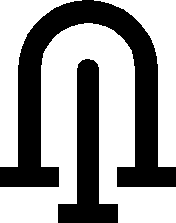
key to the Ichnographia Campus Martius
plus this.
2006.02.12 18:27
African American architecture?
Fields presents a very interesting argument that deals with Hegel's avoidance of ancient Egyptian architecture (ie, African architecture) when he, Hegel, first writes about art history.
2006.02.12 18:42
African American architecture?
Julian Abele was Horace Trumbauer's protégé. Trumbauer had no formal architectural education, but he did pay for Abele's education at the Beaux Arts in Paris, that is, after Abele graduated as the first African-American architecture student from the University of Pennsylvania.
2012.02.12 12:00
Murcia City Hall, Moneo and Pienza, perhaps?
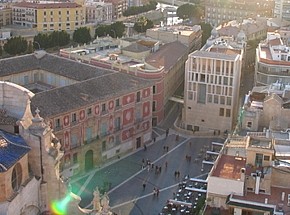
...for your comparison to be a success, you must present the whole of the Murcia piazza, and not just the City Hall by Moneo--just as you present the whole of the Pienza piazza above. The City Hall facade may relate somehow to the facade of the opposite Cathedral, as it already seems to be a (contextual) blend of the two buildings to either of its sides--the modern glass facade slipped behind the gridded pattern of the Palazzo.
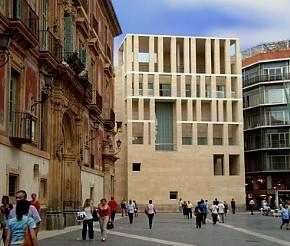
A look through Camillo Sitte's The Art of Building Cities may also aid in fleshing out the comparison.
2012.02.12 14:13
Murcia City Hall, Moneo and Pienza, perhaps?
The City Hall Annex as (Semperian) weaving (into) the urban fabric?
aside: Among other things, Minerva is the goddess of weaving, so what exactly is the Atrium Minerva doing within the garden of satire?
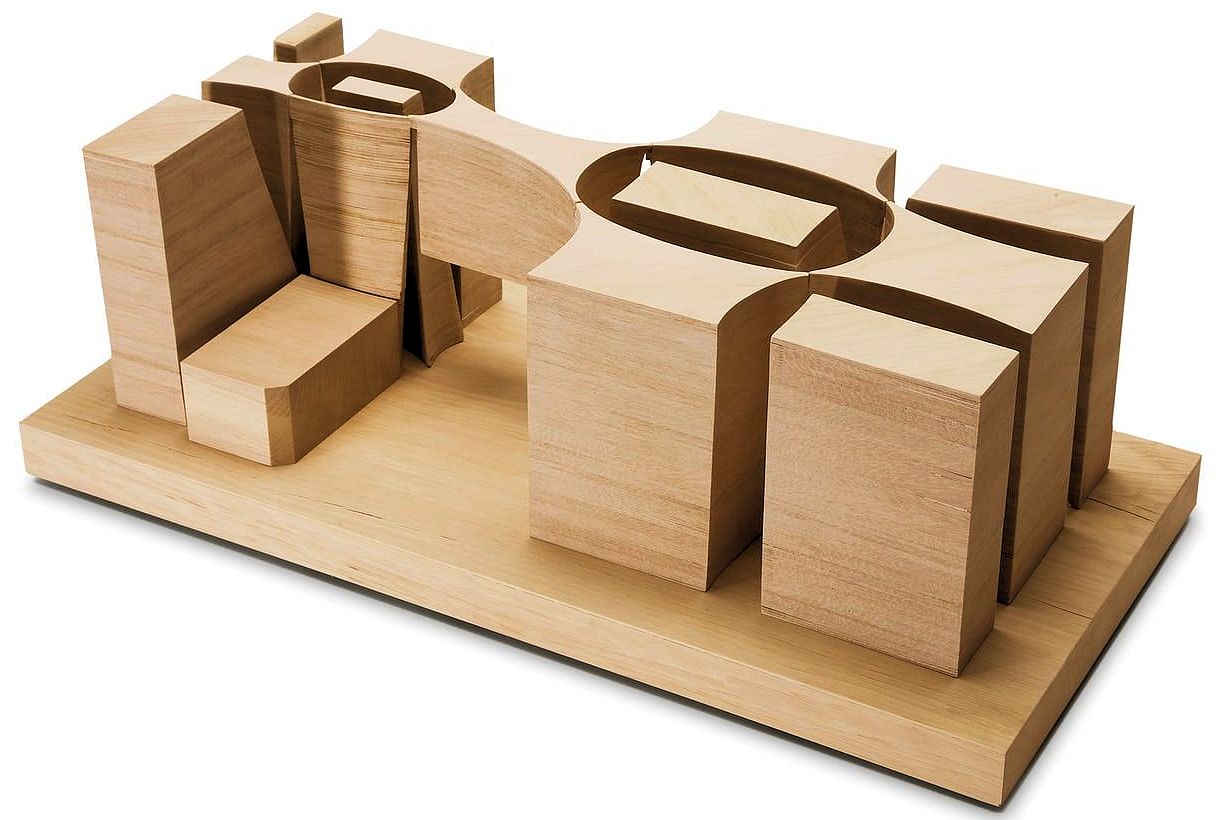
13021201 Courthouse Plus Ultra model roofless
2399i04
b
13021202 Courthouse Plus Ultra model roofless axonometrics
2399i05
17021201 Allied Works National Music Centre of Canada
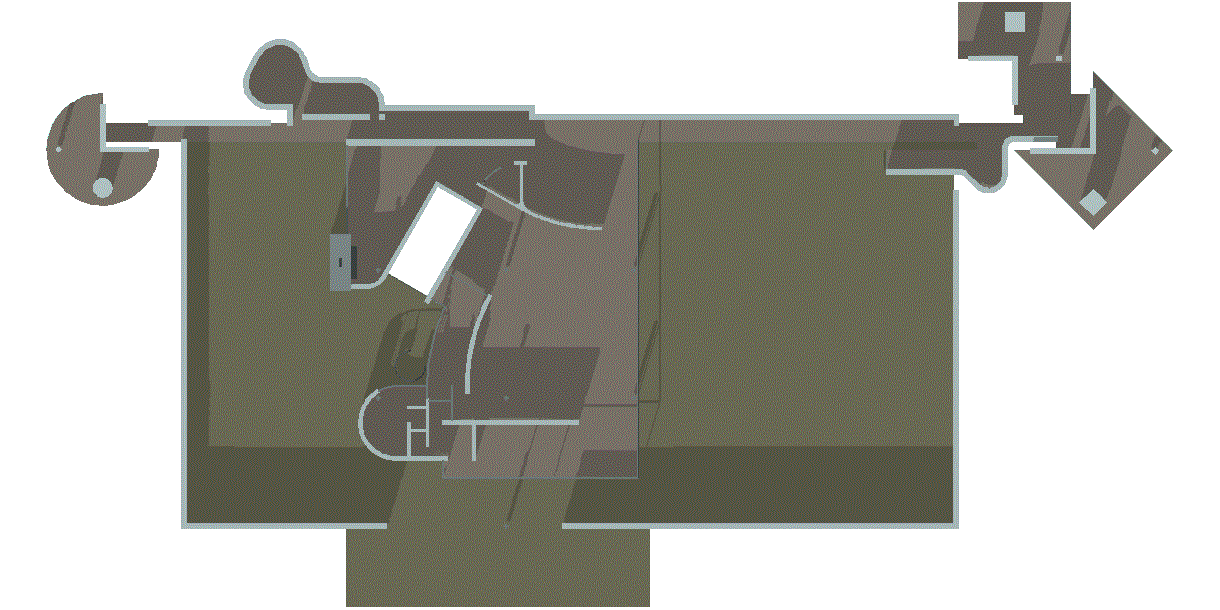
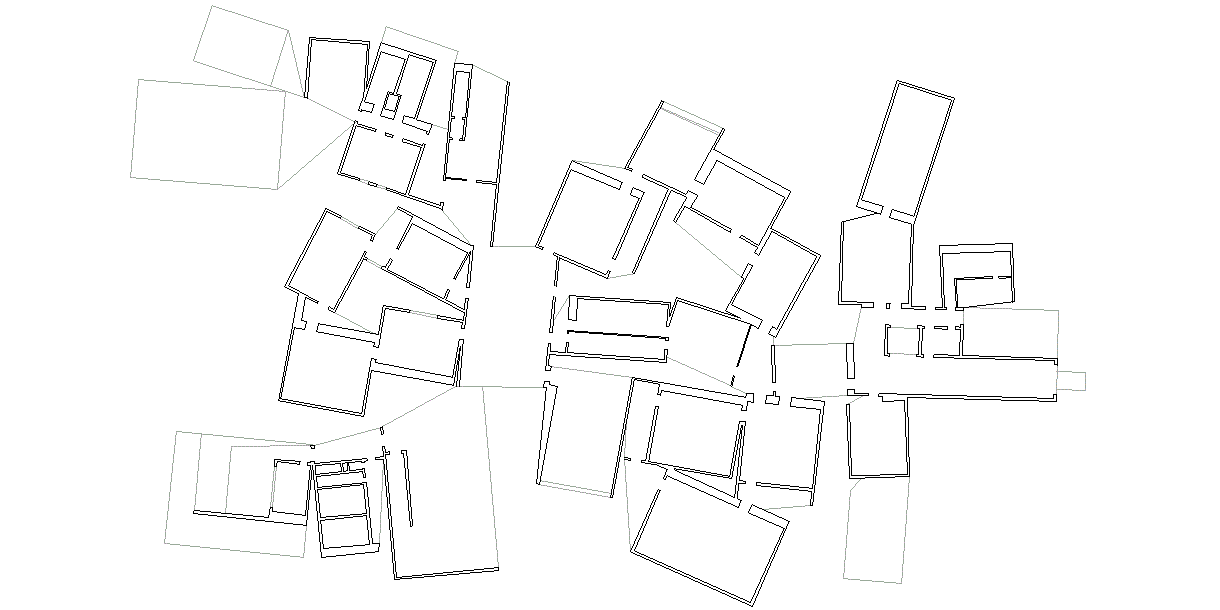
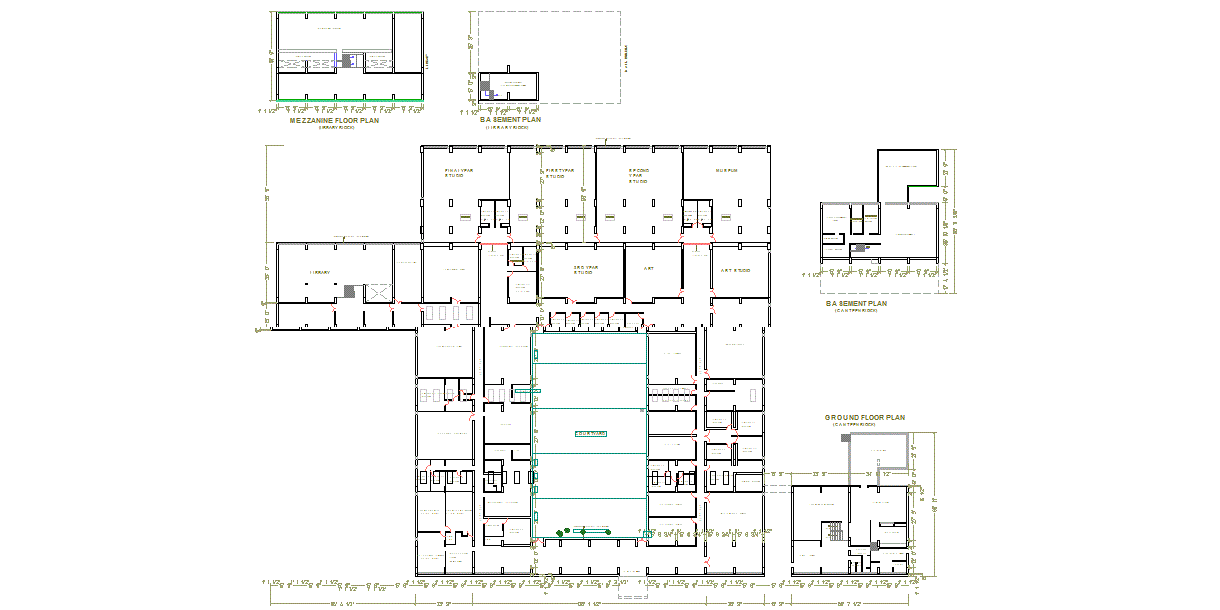
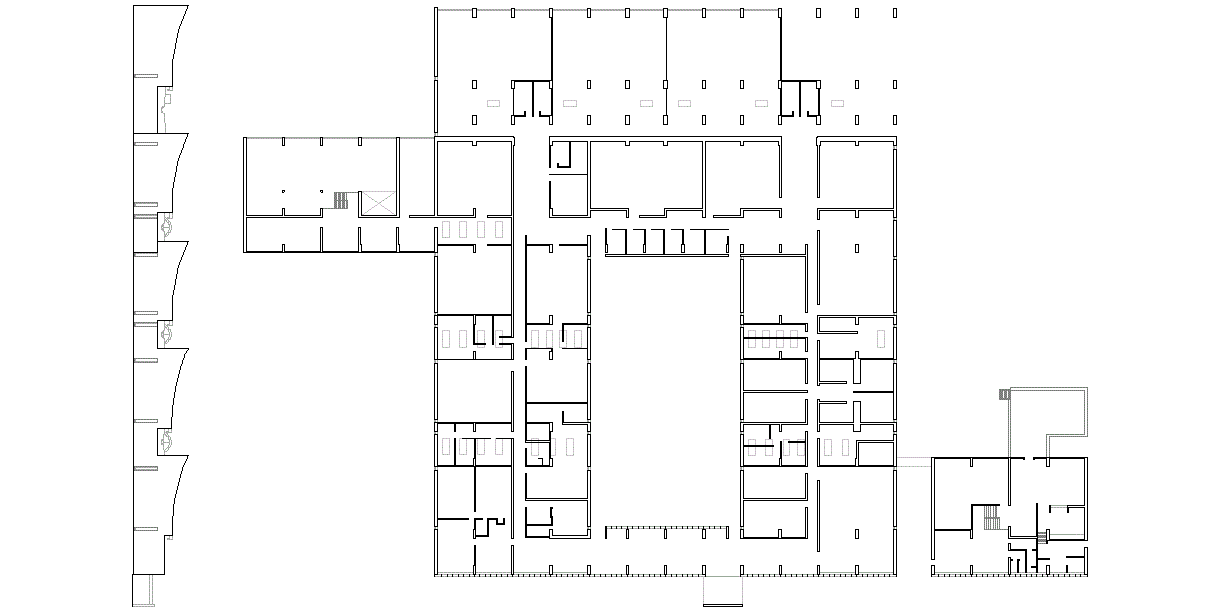
18021201 Ideal City Reenactment Fragment Museum Palace of Ottopia Lauf Haus der Kunst Palais House 10:Museum [virtual] Museum Museum Danteum Plus Ultra NeuHaus 10 der Künste IQ50 plans
2297i07
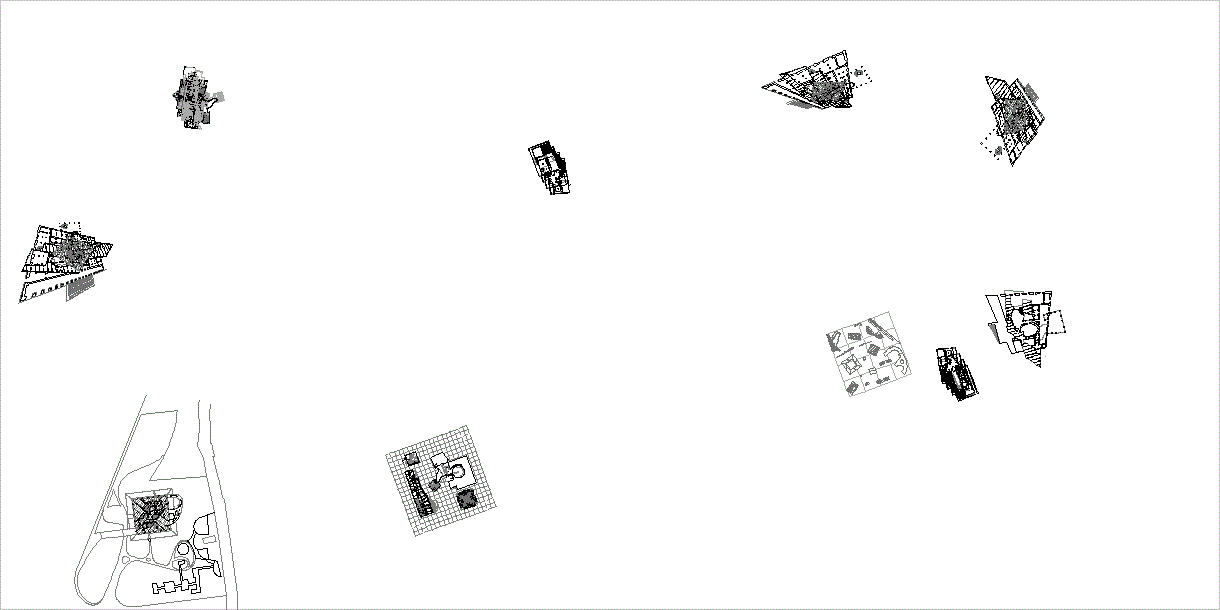
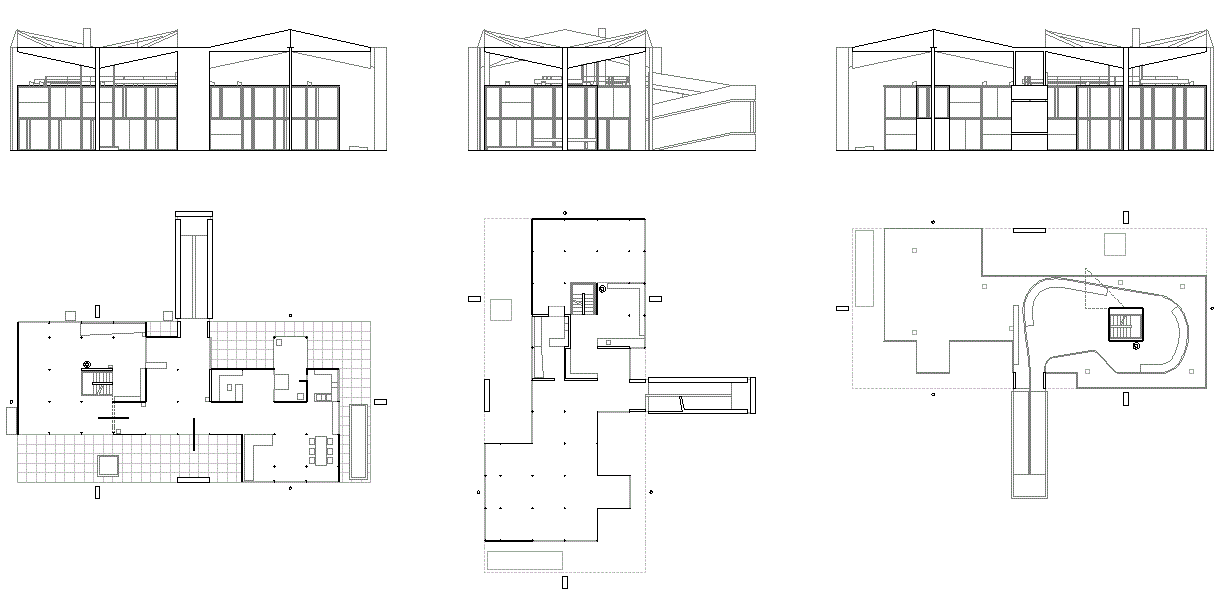
18021202 Palace of Versailles Altes Museum Whitemarsh Hall Philadelphia Museum of Art Villa Savoye Tugendhat House Danteum Arbor Street House Farnsworth house Museum of Knowledge Maison de l'Homme House 10: Museum Kimbell Art Museum Wall House 2 Museum for Nordrhein Westfalen Wallraf-Richartz Museum Atheneum Neue Staatsgalerie Museum of Arts and Crafts Museum of Architecture Institute of Contemporary Art Acropolis Q Museum Annex Analogous Building Cut & Paste Museum Circle Squared Museum Ideal City Reenactment Fragment Museum Palace of Ottopia Lauf Haus der Kunst Palais House 10:Museum [virtual] Museum Museum Danteum Plus Ultra NeuHaus 10 der Künste IQ50 plans
2297i08
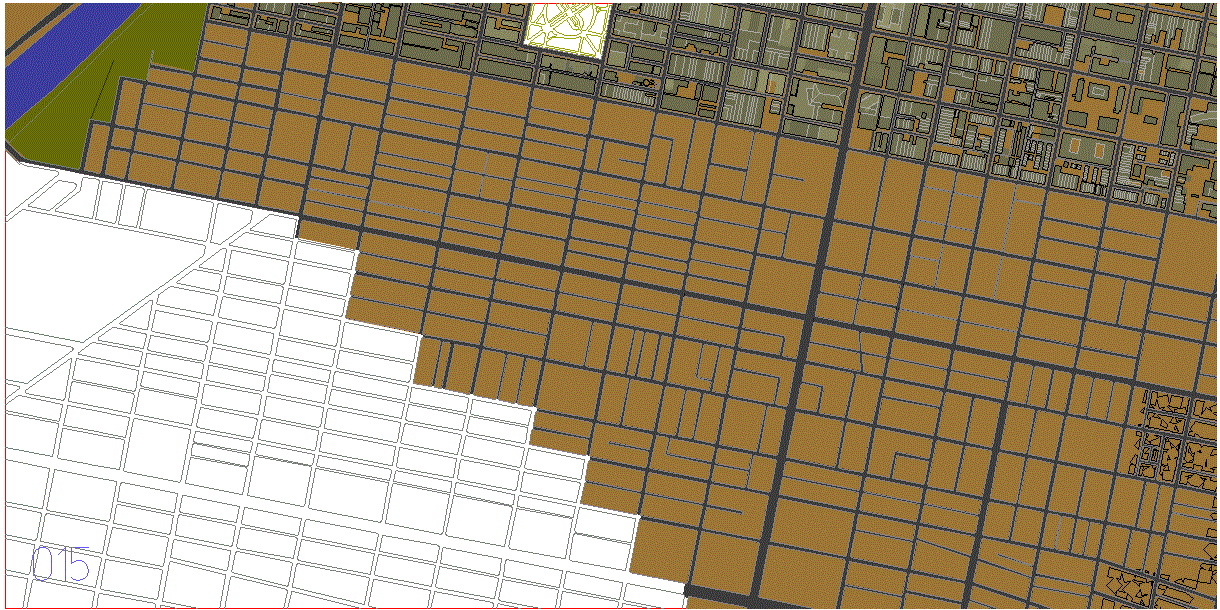
19021201 Philadelphia IQ15 plan model working data
2093i82
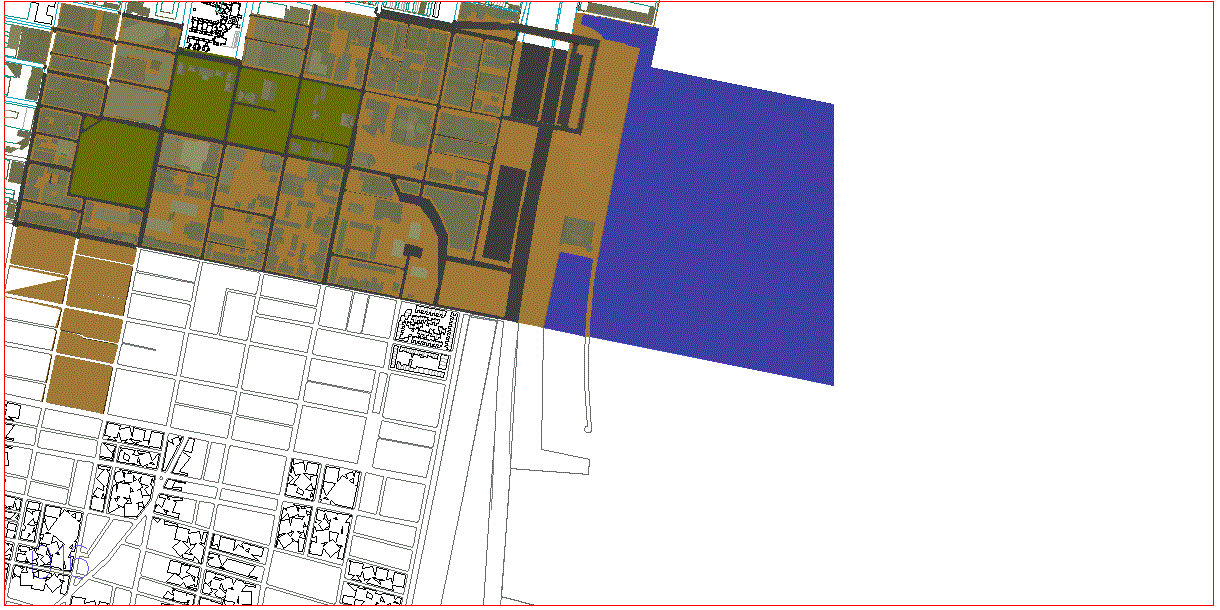
19021202 Philadelphia IQ16 plan model working data
2093i83
19021203 Philadelphia IQ18 plan model working data
2093i84
|